


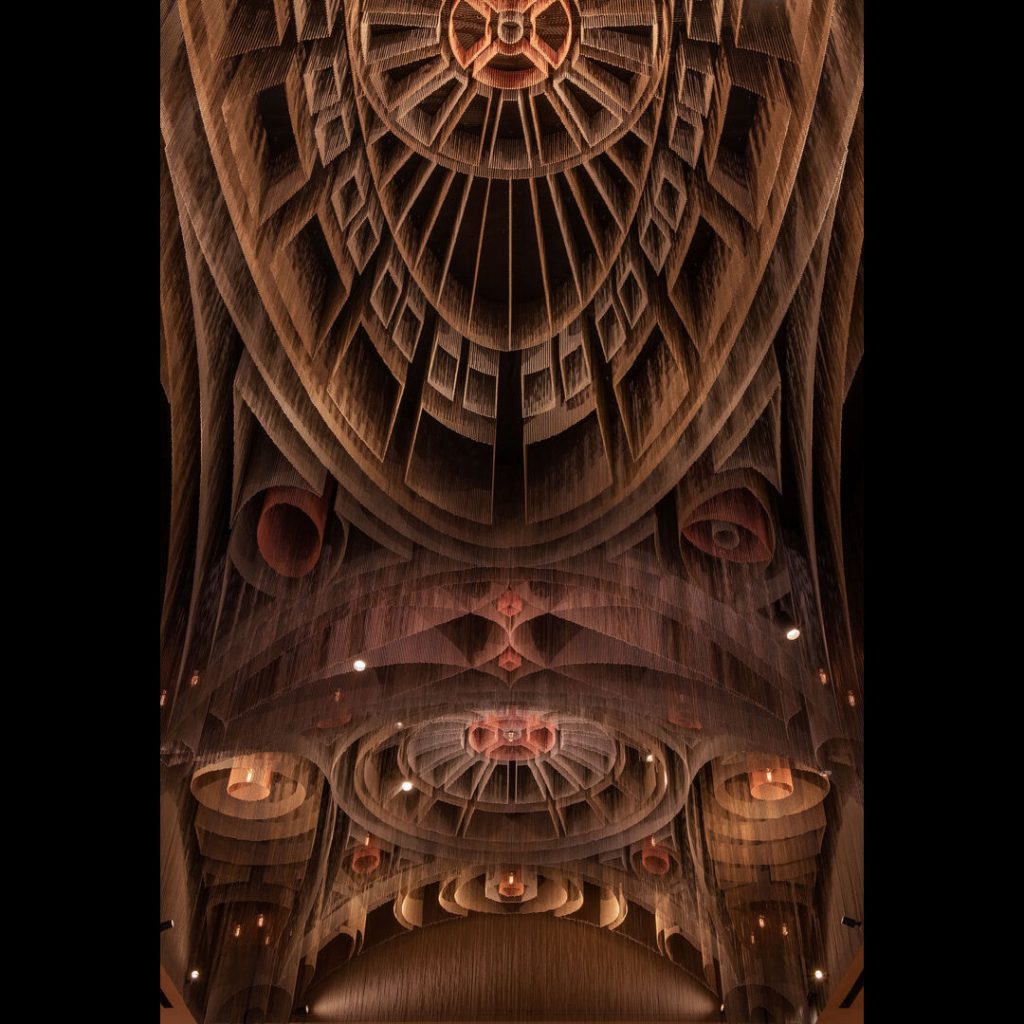
When Rockwell Group commissioned willowlamp to create the sculptural lighting ceiling art installation as a bespoke lighting concept for Cathedrale Las Vegas – a restaurant project situated in the Aria Hotel, we knew we were stepping into something extraordinary. Not because of the prestige, though yes… Rockwell Group! Because of what they were asking us to build.
12.8 metres long, 3.8 metres wide, 1.5 metres high. This wasn’t a light fitting. This was a monumental work of ceiling art that had to function as precision engineering, ship across continents in pieces, and assemble on-site without a single millimetre of error. Here’s how we did it.
The Brief: Ambition Meets Engineering Reality
The main dining room piece — what we called the MDR installation — needed to feel like liquid metal suspended in air. Flowing, organic, sculptural. The kind of large-scale chandelier design that makes you stop mid-conversation and look up.
But ambitious lighting design only works if the engineering underneath it is invisible. For Cathedrale, that meant solving simultaneously for:
Scale. Nearly 2.8 metres of continuous ceiling coverage.
Weight. 3.7 tons of product alone, before crating.
Modularity. A piece that had to ship in sections and assemble on-site, an ocean away from the studio that built it.
Precision. A 1mm tolerance across 80 individual panels.
Integration. Lighting embedded into the structure itself, not added afterward.
And it all had to arrive in Las Vegas ready to install, without it being necessary for willowlamp to be present for every step of the installation. Regardless, Adam Hoets, founder and creative director, flew to Las Vegas to personally oversee the process.
The Anatomy of a Modular Ceiling Sculpture
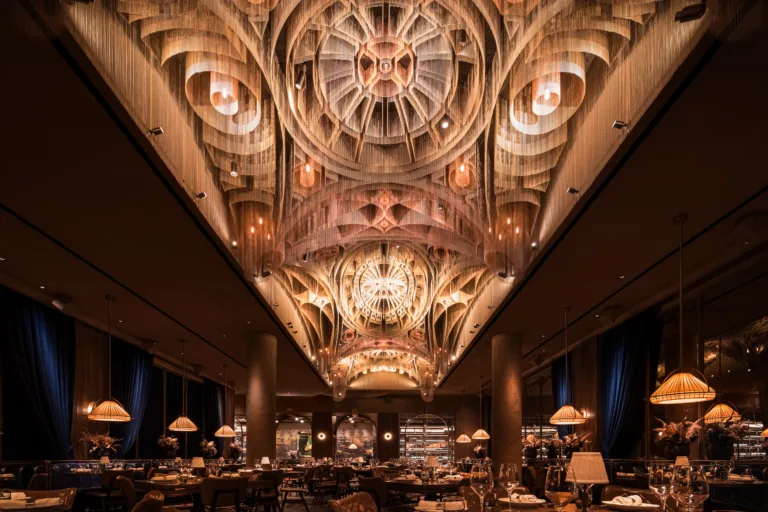
We designed the MDR piece as one centre medallion flanked by two side medallions — a triptych of cascading chain that reads as a single, unified sculpture from the floor.
Zoom in, though, and the real complexity shows. The installation comprises 34 unique panel types across 80 individual panels, each engineered to fit together like a jigsaw puzzle suspended above a working dining room.
No two panels carry the same load. Some weigh 3kg. Others weigh 98kg and measure 2 by 1 metres, requiring hydraulic lifting platforms and four people to position safely.
Across the piece, 57,000 metres of ball chain were cut in five finishes — Antique Brass, Antique Copper, Antique Nickel, Smoke, and Copper — with every length specified to follow the sculpture’s 3D contours. That specification lived in 900 pages of chain cutting schedules. Not approximate measurements. Exact ones.
Because when a custom lighting installation is this large, this visible, and this central to a hospitality space, there’s no room for “close enough.”
A Three-Layer System: Aluminium, Electrical, Chain
The Cathedrale ceiling installation runs on a three-layer modular system engineered specifically for projects at this scale.
Layer 1 — Aluminium ceiling plates.
These form the structural foundation: lightweight but load-bearing, with protruding bolts facing downward, installed flush to the reinforced ¾ inch plywood ceiling substrate with M5x30mm wood screws in a precise left-to-right sequence. Every plate is mapped to the ceiling grid before anything ships, labelled, and matched to a layout plan. The full grid is laid out on the ground first to verify the puzzle fits, then lifted and secured.
Layer 2 — Electrical integration.
This is where most large-scale ceiling installations fail: lighting treated as an afterthought, retrofitted around the decorative structure once it’s already up. Willowlamp does the opposite. We work directly with on-site lighting specialists upfront, mapping downlighting positions against the panel plan before construction begins, with the electrical cavity designed into the structure itself. When the aluminium plates went up at Cathedrale, the lighting team worked the cavity while the installation crew moved on to the next phase — no conflicts, no rework, no compromises.
Layer 3 — Decorative chain panels.
This is the art: the sculpture, the reason people look up. Each panel hangs from the protruding bolts on the aluminium plates above, secured with M6 flange nuts, with holes in the chain frames corresponding exactly to bolt positions. Lift, align, fasten finger-tight to check for flush alignment, then lock down with black dome caps over each nut. Panels hang with a 1mm tolerance between them — verified, in practice, with a folded paper jig slid between adjoining panels. That’s the level of precision a piece like this demands.
Ten Months, Concept to Installation
The Cathedrale project ran April 2022 to February 2023 — ten months from initial concept to finished installation.
The first two months went into intensive design drawings — not just the visual, but the full engineering system: every panel, every bolt position, every chain length, every crate configuration mapped before fabrication began.
Once parts arrived, eight assemblers worked full-time for two and a half months. This wasn’t assembly-line work; it was craft — each panel hand-built, each chain length verified against schedule, each fixing tested. The final structure carries 1,368 fixings across the full installation. The entire 13×2.8m assembly had to be mocked up and installed in the willowlamp factory to ensure there were no alignment errors between the modular panels.
Logistics ran to 14 crates and 5.2 tons total weight, ten crates for the main restaurant piece alone. The largest single crate measured 3m x 1.5m x 0.9m — large enough that offloading required a forklift, with pallet jacks, platform trolleys, and 22 square metres of floor space needed just to position the crates before unpacking began. Tools, spare parts, fastening hardware, and detailed manuals shipped inside their own dedicated crate, because installing on the other side of the world means planning for everything.
Precision Under Pressure: The Installation Itself
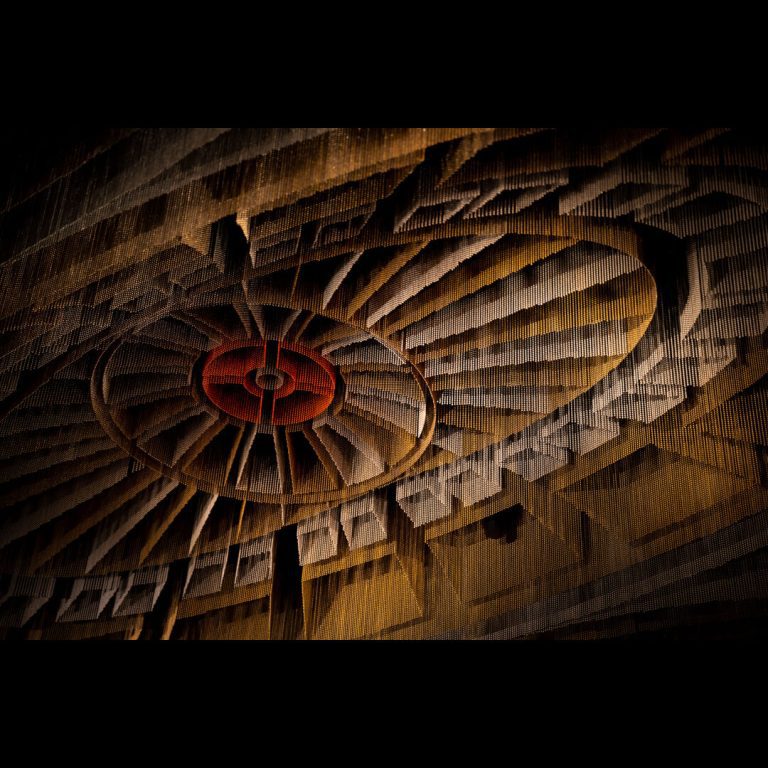
Installation specifications called for six people minimum: two teams of three for the smaller panels, four to five for the larger ones, helped along with hydraulic lifting platforms, wearing full safety equipment.
Rushing a piece like this has consequences. Panels lose alignment. The 1mm tolerance disappears. Chains catch or knot. Lighting fails to integrate cleanly. The whole sculpture loses its flow.
So the sequence is followed precisely. Panels are laid on the ground first and orientation verified before anything is lifted — carefully, with particular attention to the outermost corners where the chain curtain hangs and is most vulnerable to damage. Fastenings go in loosely at first, then tighten only once full position is confirmed. Chains are combed through by hand, checked for knots, hooks, and tangles, with round-nose pliers used to click loose links back into their notches and spare chain cut to length to replace any missing sections seamlessly. Measurements are checked intermittently against the layout plan, including a fixed 2-inch offset between the wall and the aluminium frames.
It’s treated, throughout, as the work of art it is.
What Cathedrale Taught Us About Large-Scale Lighting Installations
Projects like this don’t succeed because of product specifications. They succeed because of process.
Willowlamp didn’t simply deliver a ceiling installation to Cathedrale Las Vegas — we delivered a system: engineered, fully documented, and designed for real-world installation by teams we would never meet in person. That requires a particular kind of design thinking. You design for modularity without sacrificing visual continuity. You engineer for precision without making the installation impossibly complex on-site. You integrate lighting from day one, not as an afterthought bolted on later. You document everything: not just what to do, but why, and in what sequence.
You ship tools and spares because you know something will need adjustment on-site. You label every panel because confusion is the enemy of quality at this scale. You build weight lists so installation teams know which lifting equipment to use before they ever touch a panel.
In short, you think like an installer as much as a designer. And when it all comes together — when 80 panels align within a 1mm tolerance, when 57,000 metres of chain cascade exactly as envisioned, when the lighting integrates seamlessly into the structure above a working dining room — that’s when the engineering proves itself worth it.
The Result: Engineering as Invisible as the Art Is Visible
This installation transformed a simple ceiling into an immersive dining experience that felt like liquid metal was suspended in the air above you. Organic. Flowing. Effortless.
Behind-the-scenes, however, one would see 900 pages of cutting schedules and1,368 fixings. Ten months of planning, two and a half months of hand construction, and a three-layer modular system that made the whole sculpture possible.
Great custom lighting design doesn’t announce its engineering. It simply works — beautifully, precisely, permanently.
For architects, interior designers, and hospitality owners considering large-scale ceiling installations: this is what becomes possible when ambition is treated as an engineering challenge rather than a creative limitation. The scale doesn’t deter us. The complexity doesn’t slow us down. The logistics don’t compromise the vision.
We build systems that make the impossible achievable, in a way that lets the art speak entirely for itself. Get in touch to talk through what’s possible for your next project.