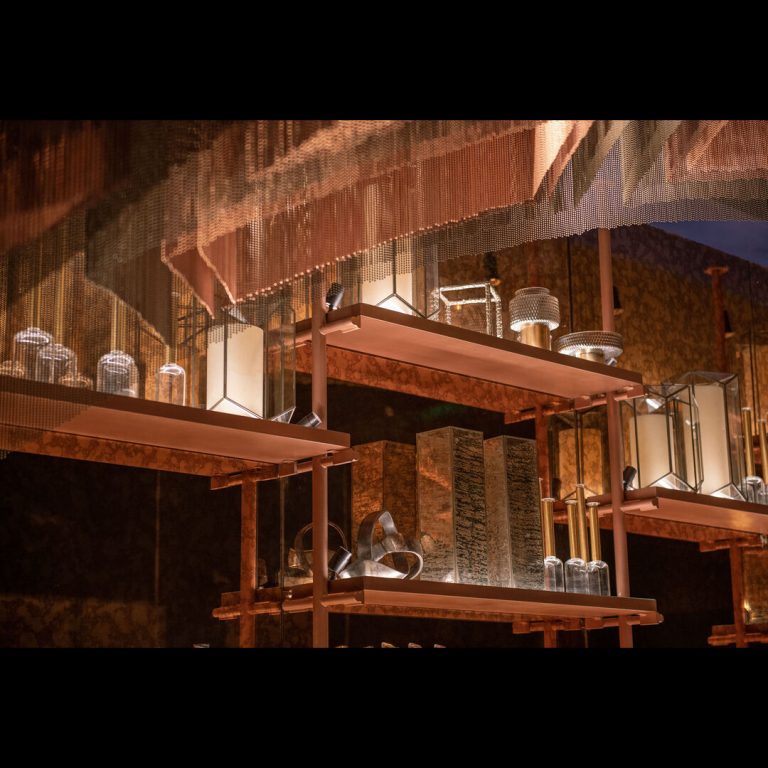


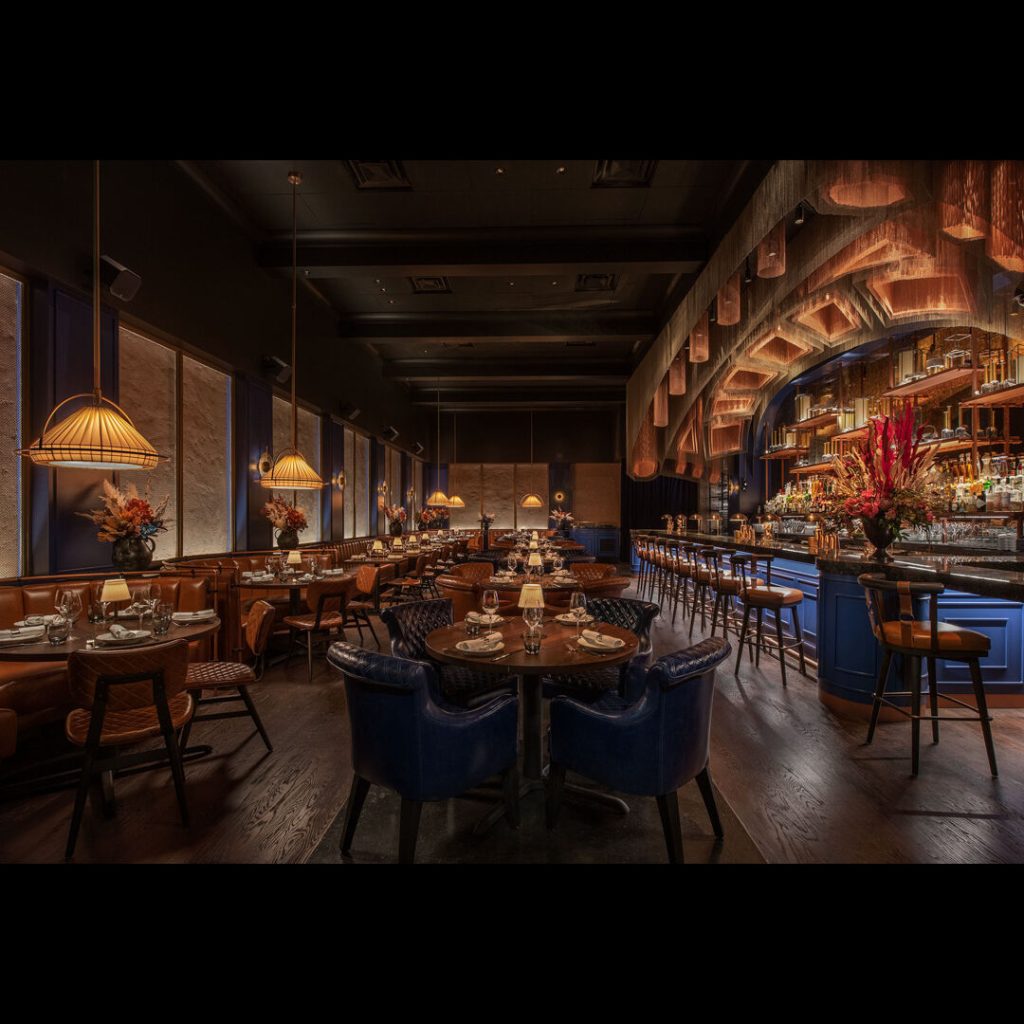
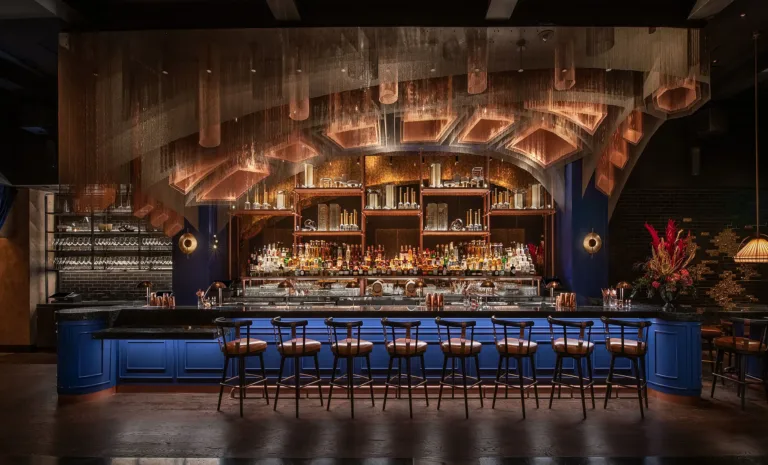
We’ve spent years making chain installations that hover. The bar installation piece at Cathedrale Las Vegas doesn’t hover, it drops. 2.8 metres of vertical fall. That’s the difference between a ceiling treatment and an architectural envelope. When Rockwell Group commissioned willowlamp to create a companion piece for Cathedrale’s main dining room, they didn’t ask for the same design, scaled down. They asked for something that would turn the bar into its own world. The dimensions tell the story: 8.9m long, 2.2m wide, 2.5m high. Narrow. Deep. Immersive. Where the restaurant installation floats above the room like a decorative canopy, the bar piece wraps around you. It changes the light. It changes how people move through the space.
Twenty-one modular panels shipped from our Cape Town studio to Las Vegas in four crates. Each crate averaged 380kg. The full project — bar and restaurant installations combined — weighed 5.2 tons with crating, 3.7 tons of pure product.
The bar piece alone accounted for a significant share of the 57,000 metres of ball chain cut for this commission, across five finishes: Antique Brass, Antique Copper, Antique Nickel, Smoke, and Copper. Every length of chain was cut to a specific measurement, mapped against 900 pages of cutting schedules built to follow the piece’s 3D contours. The tolerance between panels: 1mm. You don’t arrive at that kind of precision by accident. You get there by treating a decorative lighting installation as a structural system, engineered with the same discipline as the building around it.
The Modular System: Engineered to Travel, Built to Last
The full Cathedrale project ran from April 2022 to February 2023 — ten months from first sketch to finished installation. The first two months went into technical drawings: not concept sketches, but precise panel layouts and chain schedules, with every metre of chain accounted for before a single component was ordered. Once materials arrived, eight assemblers spent two and a half months constructing both the bar and restaurant pieces by hand — each panel individually placed into its notches, verified against the cutting schedule, and quality-checked at multiple stages. The final count: 1,368 fixings and fasteners across the full installation, each one placed exactly where the drawings said it should go.
Large-scale chandelier installations live or die on one question: how do you ship something this complex and have it reassemble perfectly, thousands of kilometres from where it was made? For Cathedrale, the answer was a two-layer modular system: aluminium ceiling plates with protruding bolts, and decorative chain panels that hang from them on M6 flange nuts.
Layer 1 — Aluminium Ceiling Plates.
Large, light, and fixed directly to the reinforced plywood ceiling with M5x30mm wood screws, each plate carries protruding bolts facing downward and is marked against a master layout plan. Plates were positioned on the floor first to verify the composition before being lifted into place. Installers loosely attach only half the screws per panel at first, tightening everything only once the full layout is confirmed — leaving room to adjust before committing.
Layer 2 — Decorative Chain Panels.
These are the sculptural elements: the chandelier itself. Holes in each chain frame aligned with the protruding bolts on the ceiling plates above. Each panel was lifted into position, fastened with flange nuts, and capped with a black dome fastener. This design system is elegant because it’s reversible — the entire installation can be disassembled and relocated if needed. The bar piece had its own sequence, distinct from the restaurant installation, which builds left to right. The bar builds back to front. Ceiling plates went up uniquely numbered panels using a particular sequence, with only one correct fit, much like a gigantic puzzle. The full composition was laid out on the ground before anything is lifted — not as best practice, but as a fixed rule, since each piece weighs between 3kg and 98kg. Installation specifications called for a minimum of six people: two teams of three for smaller panels, four to five for the larger ones, with pallet jacks, forklifts, platform trolleys and lifting platforms on site. The crates were too heavy to move by hand. The panels were too large to eyeball into place. Tools, spare chain, fastening hardware, and full installation manuals shipped in their own dedicated crate. Nothing about the install was left to assumption.
The lighting for the Cathedrale bar installation wasn’t an afterthought bolted on after the chandelier was hung — it was engineered alongside it, with on-site lighting specialists involved before construction began. Downlighting was mapped against the panel plan, with fixture placement and access requirements built into the aluminium ceiling plate design from the outset. While one crew installed the bar’s ceiling plates, a second team worked the lighting cavity inside the restaurant piece in parallel. By the time the chain panels went up, the lighting was already in place and tested. That’s the advantage of a true modular system: structure and systems can be staged simultaneously. The bar piece doesn’t just look different from the restaurant installation alongside it — it performs differently in the space. Dropping chain 2.5 metres into a space doesn’t decorate a ceiling; it builds a room within a room. The chain absorbs sound. It diffuses light. It defines boundaries without blocking sightlines — intimacy without claustrophobia, energy without chaos. The installation’s verticality pulls people toward it, turning the bar into a destination rather than a pass-through. Its narrow proportions sharpen the effect. At 2.2m wide, the piece doesn’t sprawl outward; it focuses, drawing the eye down the length of the bar and holding it there. Guests are aware of the ceiling without quite looking at it. They’re inside it. This is what happens when a high quality solid metal chain is treated properly as an architectural material rather than a decorative finish.
A Collaborative Process, From Concept to Commission
When Rockwell Group approached willowlamp, they didn’t hand over a finished design to execute. They brought a vision and a space, and we worked together to find out what was possible. That’s how every large-scale willowlamp commission works. We aren’t order-takers; we’re collaborators. You bring the architectural intent. We bring the material knowledge, the engineering systems, and the installation expertise — telling you what’s possible, what’s risky, and what will need a custom solution built from scratch.
For Cathedrale Las Vegas, that meant a modular panel system engineered to ship internationally, survive transit, and reassemble to a 1mm tolerance. It meant mapping lighting integration before a single piece of chain was cut. It meant 900 pages of cutting schedules so the installation team could verify every panel against the plan, on site, under pressure.
If you’re specifying large-scale decorative lighting for a hospitality project, Cathedrale’s bar installation demonstrates something worth building into the brief from day one: scale is a design variable, not just a size measurement. Verticality can create intimacy. Modular engineering can deliver precision at a scale that would otherwise be unworkable. Lighting, acoustics, and structure can be integrated into a single sculptural gesture — but only if that integration happens upfront, in the engineering, not retrofitted once construction is underway. We spent ten months on this project because that’s what it took to get it right. The bar piece isn’t simply a smaller companion to the restaurant installation above it. It’s a distinct spatial experience that happens to share the same material vocabulary — laser-cut steel, a patented notch system, and chain set in motion by nothing more than the air in the room.
We don’t just make beautiful objects. We make beautiful objects that work in the real world — installed by real people, under real site conditions.
If you’re working on a hospitality, residential, or commercial project where the lighting installation needs to do more than decorate, we should talk.